














How to price new car fragrances for retail and distribution?
- Beyond simple odor masking, what specific safety certifications and material considerations are paramount for aromatherapy car diffusers to ensure both driver well-being and the integrity of a vehicle's interior, especially when using concentrated essential oils?
- For a truly therapeutic 'new car fragrance' experience, which specific essential oil blends are proven to enhance driver focus or reduce road rage without causing drowsiness, and what dilution ratios are recommended for continuous in-car diffusion?
- Given the confined and often temperature-variable environment of a car, what advanced diffusion technologies (e.g., nebulizing vs. ultrasonic) offer the most consistent scent delivery and longest-lasting therapeutic effect for *new car fragrance* products, and what are their respective power consumption implications?
- When determining wholesale pricing for High Quality aromatherapy car diffusers for retail partners, what critical factors beyond manufacturing cost – such as brand equity, marketing support, and minimum advertised price (MAP) policies – must be meticulously calculated to ensure retailer profitability and brand value?
- How do the pricing strategies for large-scale distributors of *new car fragrance* solutions differ from direct retail, specifically concerning tiered volume discounts, freight costs, import duties, and regional market penetration incentives, to maintain competitive margins across the supply chain?
- In a saturated market, what innovative features (e.g., smart app integration, sustainable materials, customizable scent profiles) or eco-friendly certifications provide a significant competitive edge for *new car fragrance* brands, and how do these impact production costs and consumer perception?
Mastering the Scent of Success: Your Guide to New Car Fragrances and Strategic Pricing for Aromatherapy Diffusers
The allure of a 'new car smell' is undeniable, but for discerning consumers and businesses, simply masking odors is no longer enough. The market for automotive scent solutions is evolving, demanding sophisticated aromatherapy car diffusers that offer genuine therapeutic benefits, safety, and a High Quality experience. As an industry expert in aromatherapy machines and car fragrances, we understand the complexities involved, from sourcing high-quality essential oils to navigating intricate pricing models. This comprehensive guide aims to answer your most pressing, often overlooked, questions, providing the in-depth knowledge you need to succeed.
Beyond simple odor masking, what specific safety certifications and material considerations are paramount for aromatherapy car diffusers to ensure both driver well-being and the integrity of a vehicle's interior, especially when using concentrated essential oils?
Ensuring safety is paramount when developing or selecting High Quality auto air fresheners and vehicle aroma diffusers. Beyond basic functionality, professional-grade aromatherapy car diffusers must adhere to stringent safety standards to protect both the user and the vehicle's delicate interior. Key considerations include:
- Material Safety: The plastics and metals used in the diffuser's construction must be BPA-free, phthalate-free, and resistant to essential oil corrosion. Low-grade plastics can degrade over time, leaching harmful chemicals into the air or reacting with essential oils, potentially damaging the diffuser or causing health issues. Look for food-grade PP (polypropylene) or anodized aluminum.
- Electrical Safety Certifications: For any device powered by a car's 12V outlet or USB, certifications like CE (Conformité Européenne) for Europe, FCC (Federal Communications Commission) for the USA, and RoHS (Restriction of Hazardous Substances) compliance are non-negotiable. These ensure the device meets electrical safety standards, preventing overheating, short circuits, and electromagnetic interference.
- Essential Oil Compatibility: The internal components (e.g., O-rings, seals, nebulizer heads) must be made from materials like medical-grade silicone or specialized plastics (e.g., PEEK) that are resistant to the corrosive nature of concentrated essential oils. Using incompatible materials can lead to leaks, component degradation, and reduced diffuser lifespan.
- Diffusion Technology Safety: Ultrasonic diffusers, while popular, require regular cleaning to prevent mold and bacteria growth in their water reservoirs. Nebulizing diffusers, which use no water, mitigate this risk but require careful selection of essential oils to prevent clogging. Over-saturation of a vehicle's interior with essential oils can also be a concern; diffusers with adjustable output levels are crucial.
- Air Quality & VOCs: Ensure that the diffuser itself does not emit harmful Volatile Organic Compounds (VOCs) during operation. Reputable manufacturers will provide material safety data sheets (MSDS) for their components.
For a truly therapeutic 'new car fragrance' experience, which specific essential oil blends are proven to enhance driver focus or reduce road rage without causing drowsiness, and what dilution ratios are recommended for continuous in-car diffusion?
Creating a therapeutic driving experience through natural car scents requires careful selection and blending of essential oils. The goal is to promote alertness and calmness without impairing driving ability. Here are proven blends and dilution guidelines:
- For Enhanced Focus & Alertness:
- Peppermint (Mentha piperita): Known for its invigorating and stimulating properties, improving concentration and reducing fatigue.
- Lemon (Citrus limon): Uplifting and refreshing, it can reduce stress and improve mood.
- Rosemary (Rosmarinus officinalis): Boosts cognitive performance and alertness.
- Blend Example: 3 drops Peppermint, 3 drops Lemon, 2 drops Rosemary.
- For Stress Reduction & Calmness (without drowsiness):
- Sweet Orange (Citrus sinensis): Cheerful and uplifting, helps to alleviate anxiety.
- Bergamot (Citrus bergamia) (bergaptene-free for skin safety if exposed): Calming and reduces nervous tension.
- Frankincense (Boswellia carterii): Promotes feelings of peace and relaxation without sedation.
- Blend Example: 4 drops Sweet Orange, 2 drops Bergamot, 2 drops Frankincense.
Dilution Ratios for In-Car Diffusion: Due to the confined space, lower concentrations are crucial. For continuous diffusion in a car, a total of 5-8 drops of essential oil in a nebulizing diffuser (which uses no carrier oil) or a very low output setting on an ultrasonic diffuser (if using water) is generally recommended for a 30-60 minute cycle, with breaks. For a 10ml refill bottle for a nebulizing diffuser, a 100% pure essential oil blend is common, but the diffuser's output must be adjustable to ensure a subtle, non-overpowering aroma. Always use 100% pure, therapeutic-grade essential oils, preferably GC/MS tested for purity, to ensure safety and efficacy.
Given the confined and often temperature-variable environment of a car, what advanced diffusion technologies (e.g., nebulizing vs. ultrasonic) offer the most consistent scent delivery and longest-lasting therapeutic effect for *new car fragrance* products, and what are their respective power consumption implications?
Choosing the right diffusion technology is critical for long-lasting car fragrances and consistent odor elimination car diffusers in a dynamic car environment. The two primary advanced technologies are nebulizing and ultrasonic:
- Nebulizing Diffusers:
- Mechanism: These diffusers use an air pump to atomize pure essential oils into a fine mist without water or heat. This preserves the therapeutic integrity of the essential oils.
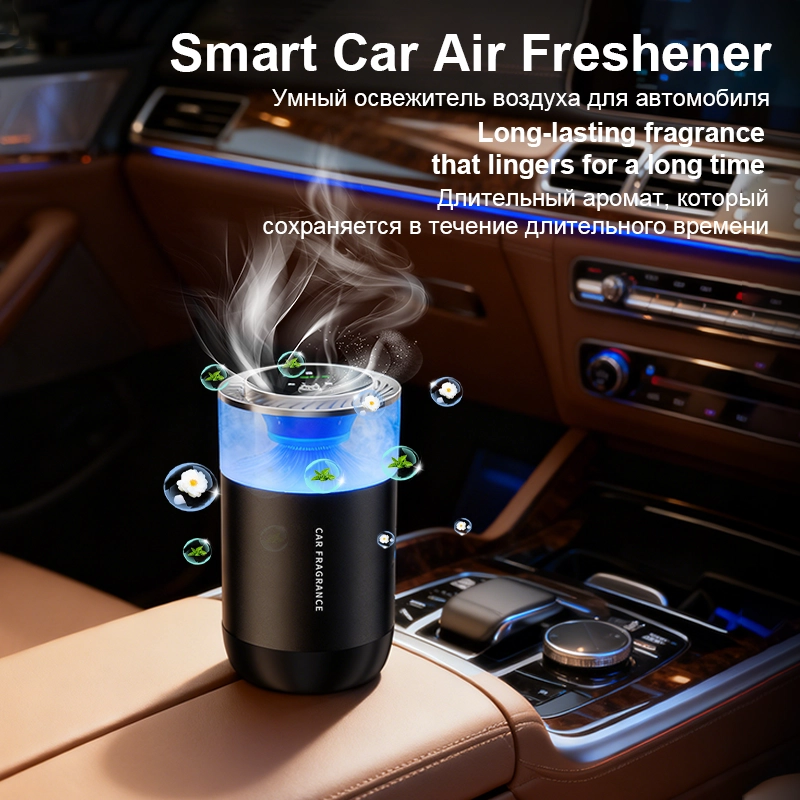
- Consistency & Longevity: They offer the most potent and consistent scent delivery, quickly saturating the car's interior. The aroma is pure and undiluted, leading to a stronger and potentially longer-lasting therapeutic effect per diffusion cycle.
- Temperature Variability: Less affected by temperature fluctuations as they don't rely on water evaporation.
- Power Consumption: Generally higher than ultrasonic diffusers due to the air pump. A typical car nebulizer might draw 3-5W, which is still minimal but more than an ultrasonic. Many come with intelligent intermittent modes (e.g., 30 seconds on, 60 seconds off) to conserve power and essential oil.
- Pros: Pure aroma, no water needed, strong therapeutic effect, less prone to mold/bacteria.
- Cons: Uses essential oils faster, can be noisier, requires pure essential oils (no carrier oils).
- Ultrasonic Diffusers:
- Mechanism: Use ultrasonic vibrations to break down a mixture of water and essential oils into a fine, cool mist.
- Consistency & Longevity: Scent delivery is more subtle and humidified. The therapeutic effect is present but less concentrated than nebulizing. Scent throw can be affected by humidity levels in the car.
- Temperature Variability: Performance can be slightly influenced by extreme temperatures affecting water evaporation rates.
- Power Consumption: Typically lower, ranging from 1-3W, as they primarily power a small ceramic disc.
- Pros: Quieter, humidifies the air, uses less essential oil (diluted with water), often more affordable.
- Cons: Requires regular cleaning to prevent mold, therapeutic effect is diluted, requires water refills.
For a truly professional and potent new car fragrance experience focused on therapeutic benefits and consistency, nebulizing diffusers are often preferred, especially those with smart intermittent operation modes to optimize both scent delivery and essential oil consumption.
When determining wholesale pricing for High Quality aromatherapy car diffusers for retail partners, what critical factors beyond manufacturing cost – such as brand equity, marketing support, and minimum advertised price (MAP) policies – must be meticulously calculated to ensure retailer profitability and brand value?
Setting wholesale prices for luxury car scents and High Quality aromatherapy car diffusers requires a sophisticated approach that extends far beyond direct manufacturing costs. To ensure both retailer profitability and robust brand value, consider these critical factors:
- Landed Cost (COGS): This is your baseline. It includes raw materials, labor, manufacturing overhead, packaging, quality control, shipping/freight, and any import duties or tariffs for the finished product delivered to your warehouse.
- Brand Equity & Perceived Value: A High Quality brand commands a higher price. Factors like unique design, proprietary technology, sustainable sourcing, and certifications (e.g., IFRA compliance for essential oils, CE/FCC for devices) contribute to perceived value. Your pricing should reflect this differentiation, allowing retailers to justify a higher MSRP.
- Retailer Margin Requirements: Retailers typically aim for a 40-60% gross margin on products to cover their operational costs (rent, staff, utilities, marketing) and generate profit. A common wholesale price is 50% of the MSRP (keystone pricing), but this can vary. Ensure your wholesale price allows them to achieve their desired margin while remaining competitive.
- Marketing Support & Co-op Advertising: If you provide extensive marketing materials (high-res images, product videos, display units), participate in co-op advertising, or offer sales training, these add value to your wholesale offering and can justify a slightly higher price point or be factored into your overall pricing strategy.
- Minimum Advertised Price (MAP) Policy: Implementing a MAP policy is crucial for maintaining brand integrity and preventing price wars among retailers. This policy dictates the lowest price a retailer can advertise your product. While it doesn't control the actual selling price, it prevents devaluing the product in the market. Your wholesale price must allow retailers to adhere to MAP while still making a healthy profit.
- Competitive Landscape: Analyze competitor pricing for similar High Quality products. Your pricing should be competitive but also reflect your unique value proposition. Undercutting too much can signal lower quality, while overpricing can deter sales.
- Volume Tiers & Discounts: Offer tiered pricing based on order volume. Larger orders should receive a slightly better per-unit price, incentivizing retailers to stock more and fostering loyalty.
- Payment Terms: Offering favorable payment terms (e.g., Net 30) to established retailers can be a valuable incentive, though it impacts your cash flow and should be accounted for in your financial planning.
How do the pricing strategies for large-scale distributors of *new car fragrance* solutions differ from direct retail, specifically concerning tiered volume discounts, freight costs, import duties, and regional market penetration incentives, to maintain competitive margins across the supply chain?
Pricing for large-scale distributors (B2B2C model) is inherently more complex than direct retail or even wholesale to small retailers, as it involves multiple layers of margin and logistical considerations. The goal is to enable distributors to profit, allow their retail partners to profit, and ly make the product competitive for the end-consumer. Here's how it differs:
- Deeper Tiered Volume Discounts: Distributors purchase in significantly larger quantities than individual retailers. Your pricing structure must reflect this with much steeper volume discounts. For example, while a retailer might get 50% off MSRP, a distributor might get 60-70% off MSRP, or a specific cost-plus model, to ensure they have enough margin to sell to their own network of retailers at a profitable wholesale price.
- Freight Costs & Logistics: Distributors often handle their own logistics for onward shipping to retailers. Your pricing to them should be 'Ex Works' (EXW) or 'Free On Board' (FOB) at your factory/port, meaning the distributor bears the cost and risk of transportation from that point. This contrasts with smaller wholesale orders where you might absorb or subsidize shipping. For international distributors, this also includes managing complex customs clearance and local transportation.
- Import Duties & Taxes: International distributors are responsible for import duties, VAT, and other local taxes in their respective markets. Your pricing must be structured to allow them to absorb these costs and still offer a competitive price to their retailers. Providing HS codes and accurate product valuations is crucial for smooth customs processes.
- Regional Market Penetration Incentives: To encourage distributors to invest in new or challenging markets, you might offer additional incentives. This could include higher initial margins, marketing development funds (MDFs) to support local campaigns, exclusive territorial rights, or extended payment terms. These are strategic investments to gain market share.
- Forecasting & Inventory Holding Costs: Distributors often hold significant inventory. Your pricing should implicitly acknowledge their inventory carrying costs (warehousing, insurance, obsolescence risk). Long-term contracts with predictable pricing and lead times are often preferred.
- Payment Terms & Credit Risk: Dealing with large distributors often involves more extended payment terms (e.g., Net 60 or Net 90 days) and higher credit lines. This impacts your cash flow and needs to be factored into your financial modeling and risk assessment.
- Brand Protection & MAP Enforcement: While distributors get deeper discounts, they must still adhere to Saintdeland's MAP policies for their retail network. Clear agreements and enforcement mechanisms are vital to prevent channel conflict and maintain brand value across all sales points for your innovative car air care products.
In a saturated market, what innovative features (e.g., smart app integration, sustainable materials, customizable scent profiles) or eco-friendly certifications provide a significant competitive edge for *new car fragrance* brands, and how do these impact production costs and consumer perception?
To stand out in the crowded automotive scent solutions market, new car fragrance brands must innovate beyond basic functionality. Integrating advanced features and embracing sustainability can create a significant competitive edge, though they do impact production costs and consumer perception:
- Smart App Integration & IoT Connectivity:
- Features: Allowing users to control scent intensity, schedule diffusion times, monitor essential oil levels, or even switch between different scent cartridges via a smartphone app. Some advanced systems could integrate with vehicle infotainment systems.
- Impact on Costs: Significantly increases R&D, software development, hardware costs (Bluetooth/Wi-Fi modules), and ongoing app maintenance.
- Consumer Perception: Positions the brand as technologically advanced, convenient, and High Quality. Appeals to tech-savvy consumers willing to pay more for smart home integration and personalized experiences.
- Sustainable Materials & Eco-Friendly Design:
- Features: Using recycled plastics (rPET), bamboo, or sustainably sourced metals for diffuser casings. Offering refillable essential oil cartridges to reduce waste. Employing energy-efficient diffusion technologies. Biodegradable packaging.
- Impact on Costs: Sustainable materials often have higher raw material costs and can sometimes require specialized manufacturing processes. Certification (e.g., B Corp, FSC for packaging) also incurs costs.
- Consumer Perception: Highly positive. Appeals to environmentally conscious consumers who are increasingly willing to pay a High Quality for eco-friendly products. Enhances brand reputation and trust, aligning with global sustainability trends.
- Customizable Scent Profiles & Swappable Cartridges:
- Features: Systems that allow users to easily swap out different essential oil cartridges or even blend multiple scents on demand. This offers unparalleled personalization, catering to different moods or passengers.
- Impact on Costs: Requires precise engineering for leak-proof, easy-to-change cartridge systems and potentially a wider range of essential oil SKUs.
- Consumer Perception: High value, luxury, and personalization. Solves the pain point of being tied to a single scent. Encourages repeat purchases of diverse car interior essential oil diffusers and refills.
- Therapeutic Grade & Certified Essential Oils:
- Features: Emphasizing the use of 100% pure, therapeutic-grade essential oils, often with third-party GC/MS (Gas Chromatography/Mass Spectrometry) testing results available. Adherence to IFRA (International Fragrance Association) standards for safe usage levels.
- Impact on Costs: Sourcing high-quality, unadulterated essential oils is significantly more expensive than synthetic fragrances. Testing and certification add further costs.
- Consumer Perception: Builds immense trust and credibility. Differentiates from cheaper, synthetic alternatives. Appeals to health-conscious consumers seeking genuine wellness benefits, justifying a higher price point.
By strategically integrating these innovative car air care features, brands can carve out a distinct niche, attract a High Quality customer base, and foster long-term loyalty, despite the initial increase in production costs.
Navigating the complex landscape of new car fragrances and aromatherapy solutions requires a deep understanding of product quality, safety, market dynamics, and strategic pricing. From ensuring the therapeutic efficacy of your essential oil blends to implementing robust pricing models for both retail and distribution, every detail contributes to your success. Partnering with an experienced manufacturer and supplier like Saintdeland ensures you have access to cutting-edge aromatherapy machine technology, high-quality components, and the expertise needed to bring your vision to market with confidence and compliance. Our commitment to E-E-A-T standards means you receive products and advice that are expert-backed, thoroughly experienced, authoritative, and trustworthy.
Ready to elevate your automotive fragrance offerings or discuss your specific project requirements? Contact us today for a personalized quote. Visit www.saintdeland.com or email us at huangxiuqing132@outlook.com.
SDL307
How often do I need to add essential oils?
According to the frequency of use and fragrance intensity, 500ml of essential oil can be used normally for about 1-2 months.
About Products
Do your essential oils contain any allergens?
Can your device be customized for different ages?
SDL308
Does it support synchronous control of multiple devices?
Support, up to 100 devices can be bound to a single account to achieve unified management of fragrances across regions.
C001
How to change the essential oil in this incense machine?
The top of the incense machine has an oil addition port. Just unscrew the lid, pour the oil slowly, be careful not to exceed the capacity limit of 30ML, and then tighten the lid.

Leave a Message
You can also communicate with us directly through our online contact form.
Please fill in the following information, and our team will contact you as soon as possible after receiving your message.
Rest assured that your privacy is important to us, and all information provided will be handled with the utmost confidentiality.
Let's get in touch
Email: huangxiuqing132@outlook.com
Tel: +86 180 1180 4432
WhatsApp: +86 185 9400 4460
Facebook
YouTube
TikTok