














Essential Oil Diffusers: The Science & Art of Scent (Advanced Guide)
Beyond the Mist: What Makes a Diffuser "Pro"?
You've used a diffuser. But do you know what's happening inside?
Ultrasonic technology vibrates water at 1.7-2.4 million times per second, fracturing essential oils into particles so fine they remain airborne for hours. This isn't just mist—it's molecular delivery.
- Beyond the Mist: What Makes a Diffuser "Pro"?
- The Quiet Revolution: Why Noise Matters
- Material Science: What Your Diffuser Is Made Of
- Particle Size: The Hidden Metric
- Temperature & Oil Integrity
- The Psychology of Scent (It's Not Just Smell)
- Cleaning Chemistry: What Actually Happens Inside
- Essential Oil Physics: Why Your Blend Disappears
- Smart Diffusers: Useful or Gimmick?
- The Pet Reality Check
- Storage Physics: Why Your Oils Die
- The 80/20 Rule of Diffusers
Beyond the Mist: What Makes a Diffuser "Pro"?
You've used a diffuser. But do you know what's happening inside?
Ultrasonic technology vibrates water at 1.7-2.4 million times per second, fracturing essential oils into particles so fine they remain airborne for hours. This isn't just mist—it's molecular delivery.
The difference:
-
Cheap diffusers: 10-20 micron particles (fall fast, wet surfaces)
-
Professional units: 1-5 micron particles (true nano-mist, hours of suspension)
The Quiet Revolution: Why Noise Matters
Sound is the most overlooked spec. A diffuser running at 35dB creates noticeable background noise. At 25dB, it disappears.
The science: Humans relax when ambient noise drops below 30dB. Your diffuser should be quieter than your breathing.
Test: Run it at night. If you can hear it from bed, it's compromising your sleep.
Material Science: What Your Diffuser Is Made Of
Most people ignore this. Don't.
| Material | Quality | Why It Matters |
|---|---|---|
| PP plastic | Basic | Safe, but can cloud over time |
| Tritan | Premium | Medical-grade, crystal clear forever |
| Glass | Luxury | Zero chemical interaction, fragile |
| Ceramic | Artisan | Beautiful, heavy, retains no residue |
The secret: Cheap plastics absorb previous oils. Your lavender today smells like last week's peppermint.
Particle Size: The Hidden Metric
Not all mist reaches your nose.
-
Large droplets (>10 microns): Fall to floor within minutes
-
Medium droplets (5-10 microns): Reach upper airways
-
Fine droplets (1-5 microns): Penetrate deep, linger for hours
Professional diffusers target the 1-5 micron range. That's where therapeutic benefit lives.
Temperature & Oil Integrity
Heat destroys essential oils. When lavender exceeds 40°C (104°F), its active compounds (linalool, linalyl acetate) begin breaking down.
Ultrasonic advantage: Creates cool mist. Room temperature diffusion preserves the plant's complete chemical profile.
Nebulizer alternative: No water, pure oil, room temp. Potent but loud, no humidity benefit.
The Psychology of Scent (It's Not Just Smell)
Olfactory nerves connect directly to your limbic system—the brain's emotion center. This is why:
-
A single sniff can trigger vivid memories
-
Scent affects mood faster than music or visuals
-
Your brain processes smell 100ms faster than pain
Strategic use:
-
Associate specific scents with activities
-
Create scent anchors (this smell = time to focus)
-
Rotate oils weekly to maintain sensitivity
Cleaning Chemistry: What Actually Happens Inside
Biofilm. It's the enemy.
Within 72 hours, stagnant water grows invisible colonies. These bacteria:
-
Create off-odors
-
Clog ultrasonic plates
-
Get misted into your air
The solution:
-
Empty after each use (don't let water sit)
-
Weekly vinegar deep-clean (acetic acid dissolves biofilm)
-
Never use soap (residue kills future scent)
Essential Oil Physics: Why Your Blend Disappears
Essential oils are volatile. Different compounds evaporate at different rates:
| Note Type | Examples | Evaporation Speed |
|---|---|---|
| Top notes | Citrus, eucalyptus | Minutes to 1 hour |
| Middle notes | Lavender, rosemary | 1-3 hours |
| Base notes | Sandalwood, vetiver | 3+ hours |
The art: Layer your blends accordingly. Top notes hit first, base notes linger.
Smart Diffusers: Useful or Gimmick?
Actually useful:
-
Timers (prevents olfactory fatigue)
-
Intermittent modes (preserves oil, extends life)
-
Humidity sensors (stops when room is moist enough)
Marketing fluff:
-
Phone apps you'll use twice
-
16-color LED shows (who needs a rave in their bedroom?)
-
"Ionic purification" claims (negligible in this form factor)
The Pet Reality Check
Cats cannot metabolize certain essential oil compounds. Their livers lack glucuronyl transferase—the enzyme that breaks down phenols.
Safe approach:
-
Diffuse in rooms pets can leave
-
Never apply oils to animals
-
Avoid: tea tree, peppermint, wintergreen, cinnamon (toxic to cats)
-
Watch for distress: drooling, lethargy, difficulty breathing
When in doubt: Skip the diffuser around animals.
Storage Physics: Why Your Oils Die
Essential oils degrade through:
-
Oxidation: Exposure to air changes molecular structure
-
Photodegradation: UV light breaks chemical bonds
-
Temperature fluctuation: Heat accelerates all reactions
Perfect storage:
-
Dark glass (amber > cobalt > clear)
-
Cool, consistent temperature (18-22°C / 65-72°F)
-
Minimal air exposure (tight caps, small bottles)
Signs of dead oil:
-
Scent becomes sharp or flat
-
Color darkens significantly
-
No therapeutic effect
The 80/20 Rule of Diffusers
80% of your experience comes from 20% of the features:
-
Particle size (1-5 micron capability)
-
Noise level (under 30dB)
-
Material quality (non-reactive, easy-clean)
-
Auto shut-off (safety and longevity)
-
Consistent output (no sputtering)
Everything else is decoration.


C007
Is it supported to use a variety of essential oils?
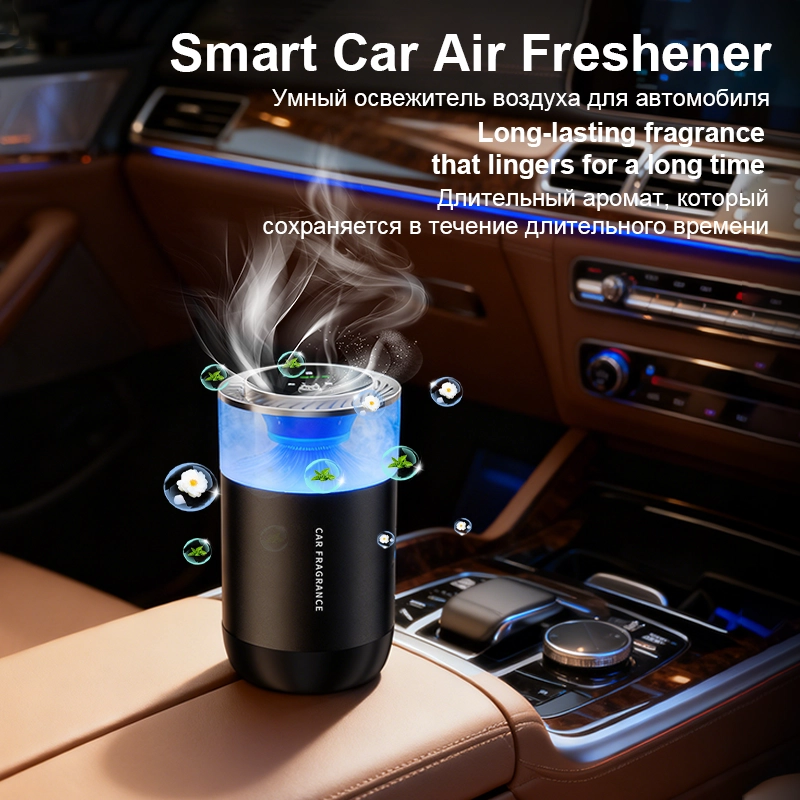
Most water-soluble essential oils are supported, but in order to ensure the best use effect and equipment life, it is recommended to use product recommendation or regular brand essential oils.
C008
Why does the air freshener not fog?
It may be that the essential oil is used up, the atomizer component is blocked or the battery is low. Check to add essential oil, clean the component or replace the battery.
OEM/ODM Services
How do you ensure product quality?
We operate under a strict ISO-certified quality management system, with in-house QC teams and advanced testing equipment. Every batch undergoes multiple inspections, including stability, scent integrity, and safety compliance.
C001
How long will a dry cell last?
The battery life is affected by the use frequency, gear setting and other factors. Under normal use conditions, ordinary dry batteries can last 1-2 weeks. It is recommended to use high-performance alkaline batteries to extend the service time.
C005
How to clean the aromatherapy machine?
After turning off the power, remove the essential oil bottle and wipe the outside of the machine with a clean soft cloth; if the internal atomization parts need to be cleaned, you can contact customer service for professional guidance. Do not disassemble it by yourself to avoid damaging the equipment.

Leave a Message
You can also communicate with us directly through our online contact form.
Please fill in the following information, and our team will contact you as soon as possible after receiving your message.
Rest assured that your privacy is important to us, and all information provided will be handled with the utmost confidentiality.
Let's get in touch
Email: huangxiuqing132@outlook.com
Tel: +86 180 1180 4432
WhatsApp: +86 185 9400 4460
Facebook
YouTube
TikTok